From 25 to 27 January 2026, Dakar, Senegal, will host a pivotal moment on the road to the 2026 UN Water Conference. Governments, UN entities, civil society organizations, and youth representatives will convene for the One-Day Stakeholder Meeting and the High-Level Preparatory Meeting, setting the political priorities, interactive dialogues, and governance architecture of the third UN Water Conference, scheduled for 2–4 December 2026 in the United Arab Emirates.
As the global water crisis deepens amid escalating conflicts and inequalities, the Dakar meeting mark a decisive opportunity to reposition water not merely as a technical or economic resource, but as a vector of cooperation, peace, justice, and equitable socio-economic development.
From Consultation to Co-Leadership
The International Secretariat for Water (ISW)—as a catalyst of the Global Youth Movement for Water and the Butterfly Effect NGO Coalition—will play an active role throughout the Dakar process and towards the UN 2026 Water Conference (December 2026). Building on years of mobilization and advocacy, ISW and its partners are working to ensure that youth and civil society priorities are elevated to the highest political level and translated into meaningful, institutionalized participation on the road to December 2026. 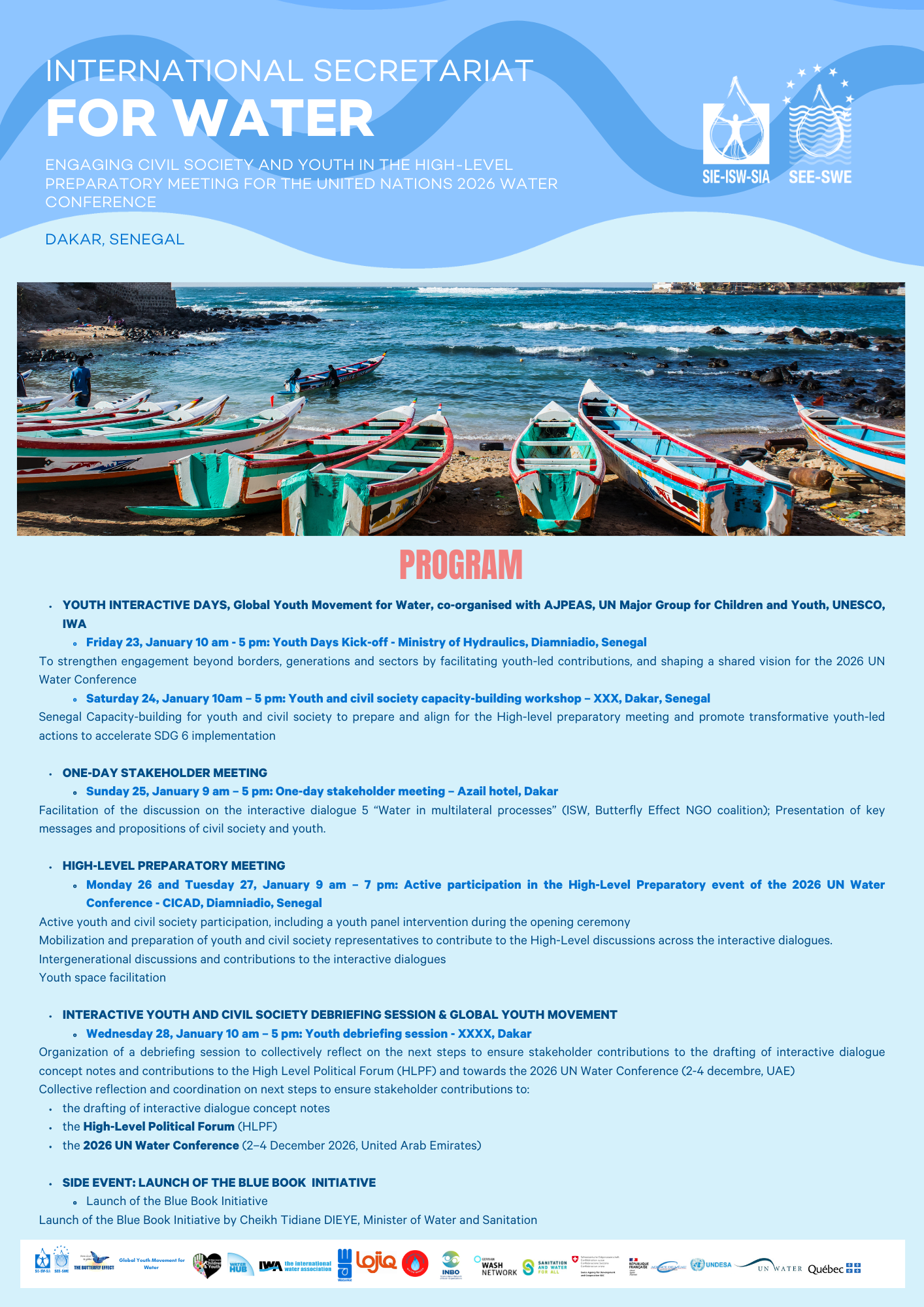
For months, ISW and its partners have been mobilizing to align priorities, influence the work of the Conference organizers, and ensure that the High-Level Preparatory Meeting is as inclusive as possible. This has included close collaboration with Senegal and the United Arab Emirates, as well as with UN DESA, enabling the participation of a well-prepared and representative youth and civil society delegation in Dakar. ISW also highlights its collaboration with LOGIQ (Offices franco-Québécois pour la jeunesse), a key partner through which several young leaders have been mobilized.
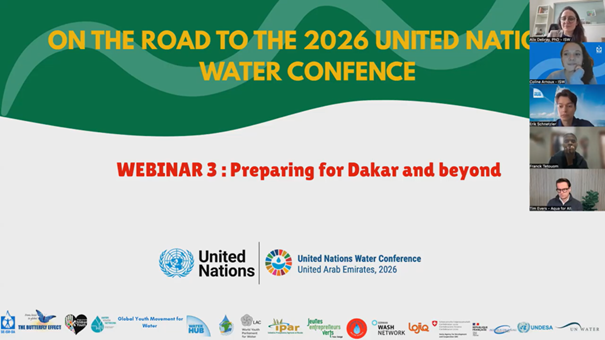
This engagement builds among others on the momentum of the third webinar in the series “On the Road to the 2026 UN Water Conference”, held on 14 January. The session gathered more than 60 youth leaders, civil society organizations, and experts to explore “Water for Peace” as a transversal lens across all six interactive dialogues of the Conference, while also sharing practical information for participation in Senegal.
Water for Peace: Key messages from youth and civil society
An in-depth presentation by the Geneva Water Hub strengthened participants’ understanding of transboundary water cooperation and highlighted the cross-cutting role of peace across the six interactive dialogue themes. Across discussions, one message emerged clearly: peace cannot be achieved without justice.
Participants emphasized that lasting cooperation depends on:
- Guaranteeing the human rights to water and sanitation for all, especially communities left behind
- Preventing the weaponization of water, including attacks on water infrastructure, supply cuts, and contamination
- Applying international water law and international humanitarian law more systematically in peacebuilding efforts
- Addressing power imbalances and existing conflicts, recognizing that cooperation cannot thrive under inequality
- Engaging youth and communities from the outset, not as an afterthought
The contradiction between chronic underfunding of water and sanitation services and massive military spending was repeatedly highlighted as a major obstacle to peace and prosperity.
Strengthening Capacity and a Collective Voice in Dakar
In the lead-up to the official meetings, ISW and its partners are organizing Youth Interactive Days and capacity-building activities to enhance coordination, strategic engagement, and intergenerational dialogue:
- 23–24 January – Youth & Civil Society Capacity-Building Workshop (Dakar)
- Preparing stakeholders to engage strategically in the High-Level Preparatory Meeting
- Coordinating youth contributions and shaping a shared vision for the 2026 UN Water Conference
- Accelerating youth-led action for SDG 6
- 25 January – One-Day Stakeholder Meeting (Dakar)
- ISW and the Butterfly Effect Coalition will facilitate discussions under Interactive Dialogue 5: Water in Multilateral Processes
- Presentation of consolidated youth and civil society messages
- 26–27 January – High-Level Preparatory Meeting (CICAD, Diamniadio)
- Youth interventions during the Opening Ceremony
- Facilitation of intergenerational dialogues
- Active participation of youth and civil society representatives across all interactive dialogues
- 28 January – Youth & Civil Society Debriefing Session (Dakar)
- Collective reflection on next steps
- Contributions to interactive dialogue concept notes, the High-Level Political Forum, and the 2026 UN Water Conference
Thematic Advocacy Priorities: From Dakar to UAE 2026
Through its mobilization in Dakar, ISW and its networks will advance key advocacy priorities aligned with three of the six interactive dialogue themes, reflecting the organization’s long-standing policy commitments:
Water for People
- Upholding water and sanitation as non-negotiable human rights
- Strengthening accountability and sustainable financing
- Supporting locally led solutions
- Recognizing water as a common good
Water for Cooperation
- Making water central to peace and security agendas
- Strengthening transboundary cooperation
- Institutionalizing the right to participation of civil society and youth
- Investing in long-term capacity building
Water in Multilateral Processes
- Strengthening global water governance
- Establishing inclusive advisory mechanisms
- Integrating water across multilateral agendas
- Preparing collectively for the post-2030 development framework
A call for institutionalized participation
ISW remains firmly committed to intergenerational, intersectoral, and transboundary cooperation. Dakar represents a critical moment to ensure that youth and civil society are not only heard, but recognized as co-architects of global water governance. 
To deliver real impact in 2026, participation must move beyond symbolic inclusion. It must be continuous, institutionalized, and grounded in shared responsibility for present and future generations.
For press and conference enquiries, please contact: Coline Arnoux carnoux@see-swe.org
To find out more, follow us on social media, follow us on Facebook, Twitter, LinkedIn and Instagram, and subscribe to our newsletter.