On 10 December, the International Secretariat for Water, in collaboration with the Butterfly Effect NGO, the Global Youth Movement for Water and other key partners, held the second webinar in the series ‘Towards the 2026 UN Water Conference’.
The objectives of this event were to:
- share the latest information on the Conference process and the high-level preparatory meeting to be held in Dakar, Senegal, on 26 and 27 January 2026
- Present inspiring advocacy initiatives
- Jointly define the thematic priorities for each of the six interactive dialogues that will be at the heart of the discussions at the Dakar meeting
More than sixty participants split into discussion rooms to co-construct youth and civil society advocacy messages for each dialogue, thereby strengthening the coordination and impact of interventions at the preparatory meeting.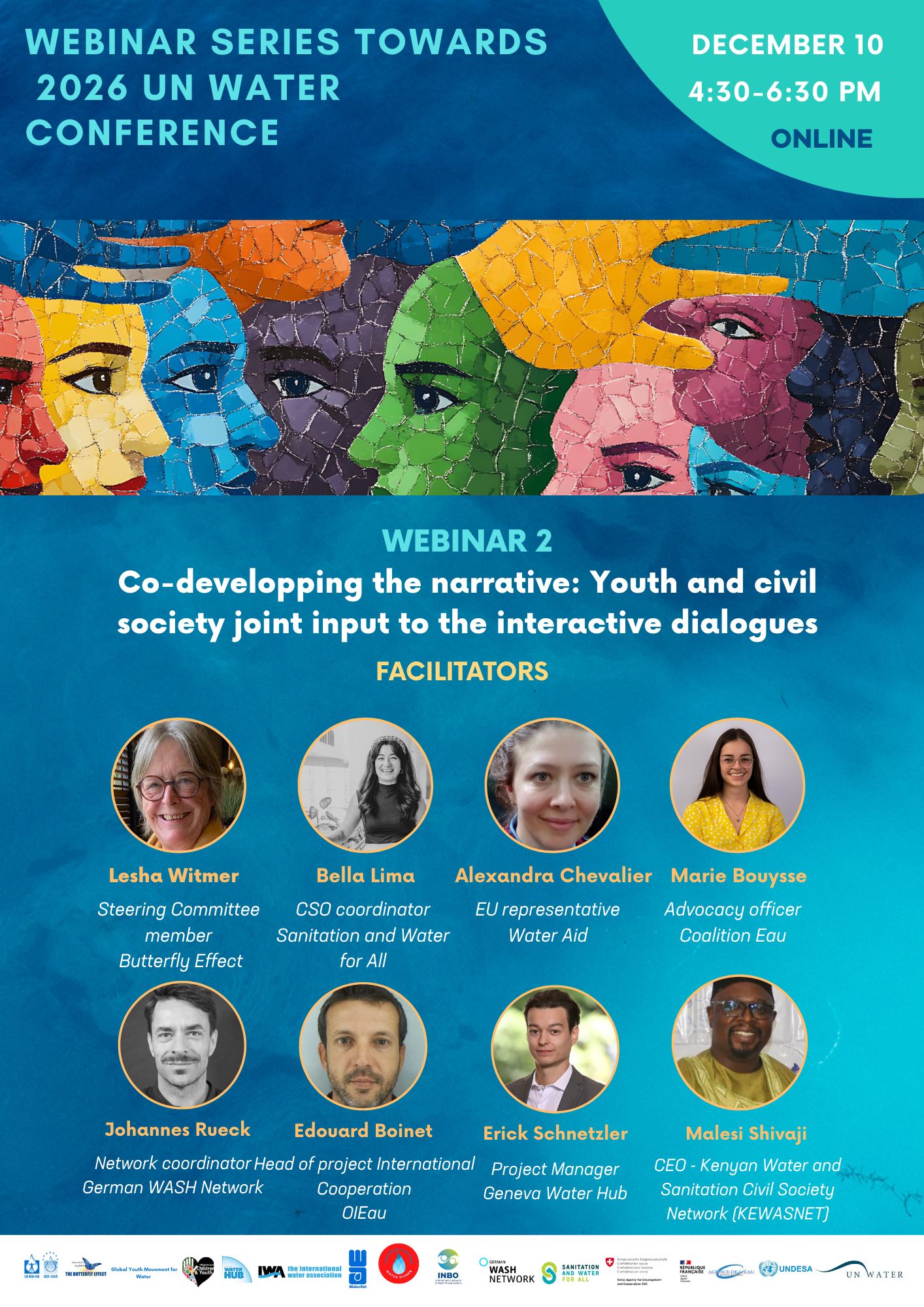
Practical information
The high-level preparatory meeting will take place on 26 and 27 January 2026 in Dakar. It will pave the way for the official United Nations Water Conference, to be held in the United Arab Emirates from 2 to 4 December 2026.
A stakeholder meeting will precede the official session on 25 January 2026, co-organised by the German WASH Network and ANEW, in collaboration with UN DESA.
The International Secretariat for Water and its partner networks will be present and will organise a youth and civil society capacity-building workshop on 23 and 24 January.
- Register for the Dakar meeting here
- Read the concept note for the Dakar meeting here
- Read the concept note for the 25 January meeting here
- Apply for your organisation to actively participate in the 25 January meeting here
- Complete this document to coordinate civil society participation in Dakar
A coordinated civil society and youth
Thanks to the support of numerous partners, the webinar helped to define thematic priorities for each interactive dialogue. Find the summary of these discussions below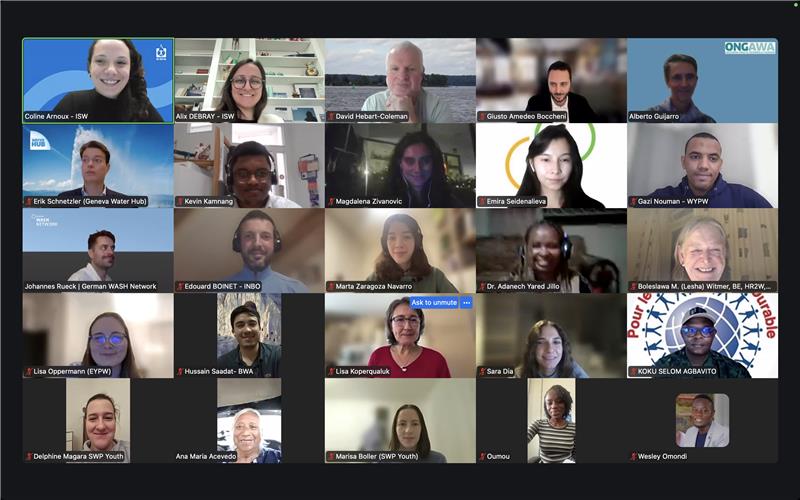
Interactive dialogue 1 – Water for the population
Summary
The dialogue highlighted water as a fundamental human right and a prerequisite for health, dignity and resilience, particularly in humanitarian and climate contexts. Participants emphasised the link between water, sanitation and hygiene (WASH) and healthcare, the devastating effects of water scarcity in crisis situations (e.g. in Afghanistan) and the persistent gaps in sanitation and access for marginalised communities. Youth emphasised education, career paths and meaningful participation of all stakeholders, while civil society called for strong post-conference accountability mechanisms, better funding for local action and more precise and transparent tools to influence decision-making.
Thematic priorities
- Water and sanitation are non-negotiable human rights: governments must guarantee universal access to safe drinking water and sanitation, particularly in situations of fragility, conflict and humanitarian emergencies.
- Finance adaptation where people live: climate finance must prioritise locally-led adaptation measures and WASH interventions that reach local and grassroot communities.
- No health without water: water and sanitation must be fully integrated into health systems to protect public health and the dignity of all.
- Accountability beyond commitments: the 2026 United Nations Water Conference must establish enforceable accountability mechanisms, particularly for private sector participation in major water-related projects
- Investing in youth as water professionals: developing scholarships, education and employment opportunities for young people, particularly those from marginalised and indigenous communities, to train young people and the next generation in the field of water
Interactive Dialogue 2 – Water for Prosperity
Summary
Discussions highlighted that poor water management harms the economy, employment, food systems and social stability. Participants identified inefficiencies in agriculture, cities and industry due to insufficient implementation of integrated water resources management (IWRM), outdated infrastructure, pollution and institutional water scarcity. While innovation is essential, it must be goal-oriented, inclusive and based on existing knowledge, including indigenous practices. Prosperity depends on strong basin governance, adequate funding, strengthened data and capacity, not fragmented sectoral approaches.
Thematic priorities
- Poor water management is an economic risk: governments must treat water as a strategic economic and social asset by investing in governance at all scales and in basin-level infrastructure
- Break down silos, prioritise IWRM: align agricultural, energy, industrial and urban policies through fully funded and inclusive integrated water resources management
- Prosperity requires equity: bridge the gaps between urban and rural areas, sanitation gaps and institutional water scarcity that disproportionately affect marginalised communities
- Useful innovation: supporting context-appropriate innovations (digital, nature-based, financial and governance-related) by building on what already works
- Setting a fair price for water, protecting vulnerable people: implementing transparent, cost-recovery tariffs systems with social protections for the vulnerable
Interactive Dialogue 3 – Water for the Planet
Summary
Participants called for a fundamental change in the way humanity relates to water and nature. Climate risks, particularly scarcity, droughts and floods, are intensifying, while economic pressures are eroding our connection to ecosystems. The dialogue emphasised holistic, nature-centred approaches. Protecting freshwater ecosystems requires moving beyond extractive, profit-driven models towards science-based, community-rooted governance that prioritises the planet.
Thematic priorities
- Protect water, the source of life: Freshwater ecosystems must be preserved as they are the foundation of climate resilience and all life on Earth.
- Change mindsets: governments should adopt a holistic approach, balancing human and environmental need/ecosystem-centred approaches
- Deploy nature-based solutions: restore wetlands, rivers and aquifers using science and “source-to-sea” approaches
- Prevent disasters: proactive and preventive measures are essential to cope with droughts, floods and shortages exacerbated by climate change
- Put life at the centre: ancestral and local practices must be at the heart of decisions relating to water and the environment
Interactive Dialogue 4: Water for Cooperation
Summary
This dialogue presented cooperation in the field of water as a means of establishing peace, justice, dignity and equity. Participants highlighted the challenges posed by colonial legacies, geopolitical tensions and competing priorities in transboundary basins. Young people and civil society emphasised that water knows no political boundaries and should never be used as a weapon. Meaningful cooperation requires inclusive governance, gender equality, the institutionalisation of young people, transparency and sustained investment, even in politically sensitive regions.
Thematic priorities
- Water cooperation is a matter of peace and justice: transboundary water governance must serve people, ecosystems and long-term stability, not be used as a political lever
- Water knows no borders: governments must cooperate and reject the use of water as a geopolitical weapon
- Invest where tensions are highest: secure and fragile regions need more investment in cooperative water governance
- Institutionalise youth and community engagement: young people, women and marginalised communities must have a formal role in water diplomacy and decision-making
- Sanitation is essential to dignity: SDG 6.2 must be considered a priority, as it is the cornerstone of cooperation and human dignity
Interactive Dialogue 5: Water in multilateral processes
Summary
Participants emphasised the need to keep water at the top of the global political agenda beyond 2030. Multilateral water governance must be continuous, inclusive and accountable. Young people and civil society called for structured participation, better coordination, disaggregated data on inclusion and closer links between water, climate and other international processes. The Special Envoy for Water and UN system-wide strategies were seen as key vehicles, provided they genuinely include stakeholders.
Thematic priorities
- Water must remain central to post-2030 concerns: establish a regular intergovernmental process on water with strong stakeholder involvement
- Take into account the diversity of opinions: multilateral processes must reflect the social, cultural, ecological and economic values of water and leave no one behind
- Institutionalise youth participation: young people must have a place in official segments, with clear timeframes, resources and integration strategies
- Strengthen access to data and monitoring of commitments: commitments must be measurable and transparent, and data must be accessible, disaggregated and regularly updated
- Integrate water into all United Nations frameworks: water must be fully integrated into climate negotiations, COPs and broader development processes
Interactive Dialogue 6: Investments in Water
Summary
This dialogue revealed a serious water financing crisis, but also untapped opportunities. Participants emphasised that effective investment starts with communities, shared knowledge, transparency and financial literacy. Innovation was redefined as a social and financial process, rather than just a technology. A key finding was that existing funds often remain unused due to a lack of capacity, clarity and access, making better use of current resources a priority.
Thematic priorities
- Put communities at the centre of water financing: investments must empower local and indigenous communities to act as decision-makers and project owners
- Bridge the funding gap through transparency: robust and shared traceability and accountability are essential to ensure that funds reach those who need them most
- Redefine innovation in water financing: innovation includes simple, tailored solutions and clearer, more attractive investment mechanisms, and is not limited to high-tech tools
- Democratise discussions on financing: young people, civil society and communities must be equipped to understand and shape water financing systems
- Make better use of existing funds before seeking new ones: strengthen financial knowledge and capacity to unlock already available resources
These thematic priorities are the result of group discussions held during the second webinar in the series ‘Towards the 2026 United Nations Water Conference’ and form the basis of ongoing work to develop common advocacy messages for the Conference. They will also provide a common framework for discussions around the six themes of the interactive dialogues at the high-level preparatory meeting in Dakar.
- Find the webinar PowerPoint presentation here
- Watch the webinar replay here
- Have a look at the detailed summary of the discussions here
Next event
Don’t miss the final webinar in the series on 14 January 2026 from 4.30pm to 6.30pm (CET).