In December 2026, the United Arab Emirates, together with Senegal, will host the third United Nations Water Conference. Around the world, young people are preparing to make their voices heard there. But the issue goes well beyond their presence in Abu Dhabi: it is about giving them the knowledge, spaces, and resources they need to contribute to decisions and become full-fledged actors in water governance.
For more than thirty years, the International Secretariat for Water (ISW) has worked to make room for young people in the spaces where the future of water is decided.
Today, this mobilization is taking on a new dimension. The Global Youth Movement for Water (GYMW), catalyzed by the International Secretariat for Water (ISW), is rolling out several joint initiatives with the United Nations Major Group for Children and Youth (UN MGCY) and numerous partners.
Capacity building, advocacy coordination, consultations, knowledge production, preparation of young leaders, and development of institutional mechanisms: these initiatives share a single objective, which is to move from occasional participation to meaningful and lasting youth participation in water governance.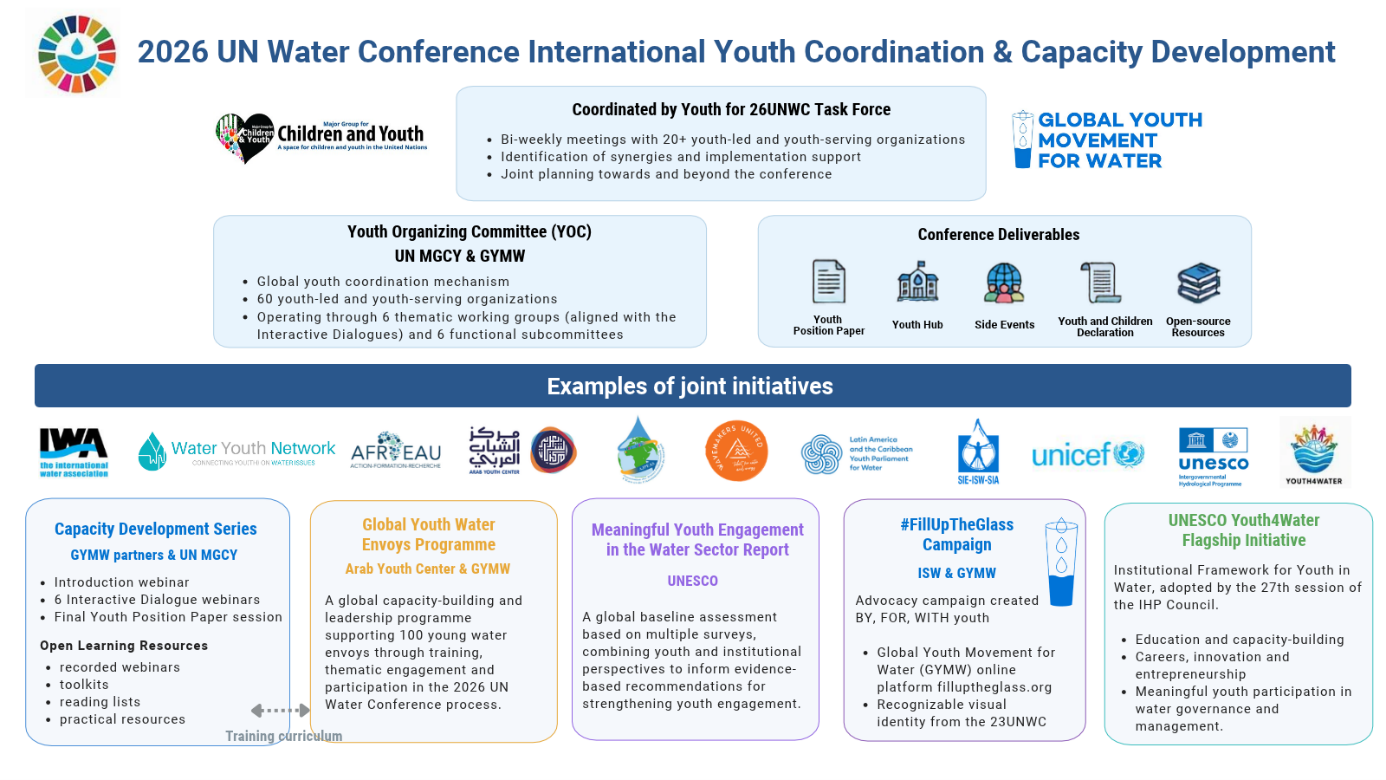
More than 60 youth organizations united to carry a common voice
At the heart of this mobilization is the Conference’s Youth Organizing Committee (YOC). It brings together more than 60 organizations that are youth-led or youth-serving. It operates with 12 sub-committees: six thematic groups aligned with the Conference’s interactive dialogues and six functional sub-committees. Their mission is to amplify youth-led recommendations, strengthen youth capacities, coordinate their participation, and produce the youth deliverables for the Conference.
The ISW leads the advocacy and mobilization sub-committee, with an essential mission: to gather and consolidate the youth positions of each thematic sub-committee into a Youth Position Paper, in order to draw common key messages that will carry the voice of young people at the Conference. It also leads the #FillUpTheGlass campaign, building on the efforts undertaken for the 2023 United Nations Water Conference.
In parallel, the “Youth for 26UNWC” Task Force, coordinated by the Global Youth Movement for Water, holds bimonthly meetings with more than 20 organizations. It identifies synergies, supports implementation, and plans joint actions before, during, and after the Conference.
The goal is clear: not to multiply isolated youth voices, but to build a lasting collective mobilization capable of influencing the outcomes of the Conference.
Quebec’s Next Generation Heads to Abu Dhabi
At the provincial level, ISW is partnering with Québec Jeunesse Monde (QJM) to support a delegation of four young people as they prepare for and participate in the 2026 United Nations Water Conference. This partnership aims to amplify the perspectives of Quebec’s next generation and encourage their active participation in exchanges and discussions, particularly within youth-focused forums.
Understanding in order to act: strengthening youth capacities
Meaningful participation also requires mastering the issues on which decisions will be made.
From July to November 2026, the Global Youth Movement for Water, the United Nations Major Group for Children and Youth, and their partners, including the International Water Association (IWA), are organizing a series of capacity-building webinars. The aim is to give young people the knowledge and tools to participate meaningfully in global water governance and contribute to progress on SDG 6. Each session explores one of the Conference’s interactive dialogues:
- Water for the planet: how nature-based solutions can complement or replace traditional infrastructure to protect aquatic ecosystems.
- Water for prosperity: how sustainable water management supports economic prosperity, social well-being, and community resilience, by involving young people in designing solutions.
- Financing for water: young professionals, financial partners, public institutions, and civil society examine financing pathways and emerging technologies to make water financing more sustainable, effective, and accountable.
- Water for people: how public institutions and services, through inclusive governance and effective regulation, can guarantee the human right to water and sanitation.
- Scientific cooperation and water diplomacy: how transboundary cooperation contributes to peace, sustainable development, and climate resilience. Only 43 of the 153 countries sharing transboundary rivers, lakes, or aquifers have operational agreements covering at least 90% of their shared waters.
The final sessions, scheduled by the end of November, will complete the full set of themes, with the next session planned for October 30 on water in multilateral processes. The final session, together with a session on advocacy methods, will be devoted to developing a common youth position on water. Recordings, toolkits, and practical resources are available in open access.
Global Youth Water Envoys
An initiative of the Arab Youth Center, in strategic partnership with the Ministry of Foreign Affairs of the United Arab Emirates and with the support of the Conference presidencies, and of the Global Youth Movement for Water (GYMW), the Global Youth Water Envoys program selects and prepares 100 young leaders from all regions of the world to take part in the Conference in Abu Dhabi. It includes foundational training, thematic specialization, and direct exchanges with national delegations and institutional partners. The ambition is for these envoys to be contributors to the outcomes of the Conference, its six interactive dialogues, and the multilateral platforms that shape the water agenda, rather than mere observers.
A compilation of youth perspectives from the water sector
UNESCO is working on the launch of the global report Meaningful Youth Engagement in the Water Sector, a benchmark assessment that combines the perspectives of young people and institutions to formulate evidence-based recommendations.
For its part, the International Secretariat for Water is publishing, in collaboration with Water Diplomat, a series of articles on youth expectations for the Conference:
- November 2025: Youth Call for Concrete Action, young people’s expectations of the Conference
- February 2026: Interactive Dialogue E, “Water in multilateral processes,” on the importance of intergenerational dialogue
- May 2026: Interactive Dialogue A, “Water for people,” on universal access to drinking water and sanitation
- June 2026: Interactive Dialogue F, “Investments in water,” on expectations regarding financing
- July 2026: Bridging the capacity gap, on the Youth4Water initiative and capacity-building gaps
- September 2026: Interactive Dialogue C, “Water for the planet,” on fragmentation between climate, biodiversity, and water
- October 2026: “From dialogue to implementation: what young people expect from water for cooperation,” on cooperation and trust
All these efforts converge toward the expected deliverables: a common youth position, a youth space, side events, a Children and Youth Declaration, and open-access resources.
In parallel, led by the ISW and the Global Youth Movement for Water, the #FillUpTheGlass advocacy campaign, designed by, for, and with young people, is gaining new momentum by building on the efforts undertaken in 2023. With renewed messages and a redesigned website, to be launched by the time of the Conference, the campaign aims to amplify youth voices and strengthen the reach of their advocacy.
Youth4Water: embedding youth participation over the long term
Among these initiatives, the Youth4Water Flagship Initiative occupies a central place. Adopted by the UNESCO Intergovernmental Hydrological Programme Council at its 27th session, and the first UN-system framework institutionalizing youth participation in the water field, it will be the subject of an official side event titled “Youth4Water: From learning to work – mobilizing education, careers and meaningful engagement for SDG 6,” to be held on Thursday, December 10, during the Abu Dhabi Conference.
This event is led by the ISW, as the operational secretariat of the initiative, and by the Global Youth Movement for Water. It is co-organized by the Ministry of the Environment of Finland, UNESCO, Khalifa University, Aquafed, the United Nations Major Group for Children and Youth, and UNICEF.
Drawing on the UNESCO report and on this flagship initiative, which is built around three pillars (education and capacity building; careers, innovation, and entrepreneurship; and meaningful youth participation in water governance and management), the event will show how Youth4Water is becoming a shared implementation platform.
It will bring together Member States, universities, youth networks, United Nations entities, and private sector partners, and will address:
- The Youth4Water scholarship and fellowship program, which mobilizes academic places, funding, mentoring, and regional access;
- The NextGen Water Workforce initiative, which links education to employer-defined training, paid internships, apprenticeships, placements, and entry-level positions;
- Meaningful youth participation, with discussion of a common mechanism to map opportunities and gaps and to report on progress in this area.
Abu Dhabi as a milestone, not an endpoint
The 2026 United Nations Water Conference is a major opportunity to advance the place of young people in global water governance. But it must not be an end in itself.
The true measure of success will be what remains after Abu Dhabi: better trained and better connected young people, more professional opportunities, youth organizations with the means to act, and, above all, mechanisms enabling young people to contribute to decisions over the long term.
This is why the ISW and its partner networks will remain mobilized before, during, and after the Conference. Our ambition is to make Abu Dhabi a turning point: to move from youth presence to youth influence, from consultation to co-creation, and from one-off initiatives to a lasting place for youth in water governance.
Because preparing the next generation of water professionals and leaders is not only about investing in young people. It is about investing in continuity, cooperation, and the future of global water governance.